
More fired heater engineers are being asked to look at HRSGs, whether on a refinery cogen unit or a new power project. The two equipment look alike on a drawing: banks of tubes, extended surface, hot gas on one side and a fluid to be heated on the other. Much of the engineering does carry across.
Not all of it does, and the differences are where the expensive mistakes happen. This article lays out what is the same, what is different, and which parts of fired heater practice transfer directly to HRSG work.
The one-line answer
A fired heater and a heat recovery steam generator (HRSG) are both tube-based heat-transfer equipment, and they run on the same fundamentals. The defining difference is where the heat comes from. A fired heater makes its own heat, burning fuel in a radiant firebox. An unfired HRSG makes no heat of its own; it recovers the exhaust heat a gas turbine already produced. That single difference drives most of the others.
What is the same
Both move heat from a hot gas to a fluid inside tubes, and both are sized with the same relationships: an energy and mass balance, the duty equation Q = U × A × LMTD across convective surface, heat flux and tube metal temperature limits, and gas-side pressure drop. The one place that relation does not govern is a fired heater's radiant box, which is sized by heat flux and a radiant-exchange method such as Lobo-Evans rather than by U × A. Both are built from the same catalog of bare and finned tubes, headers, and pressure parts designed to ASME.
The overlap is clearest in the convection section. A fired heater's convection bank, the finned-tube rows above the firebox that scavenge heat from the flue gas, is in engineering terms a small HRSG. The gas-side heat-transfer coefficients, the fin design that trades surface area against pressure drop and fin-tip temperature, the fouling and cold-end corrosion questions, and the flow-distribution problem are the same discipline in both equipment. So are the tools used to solve them: thermal rating, CFD, and mechanical design.
What is different
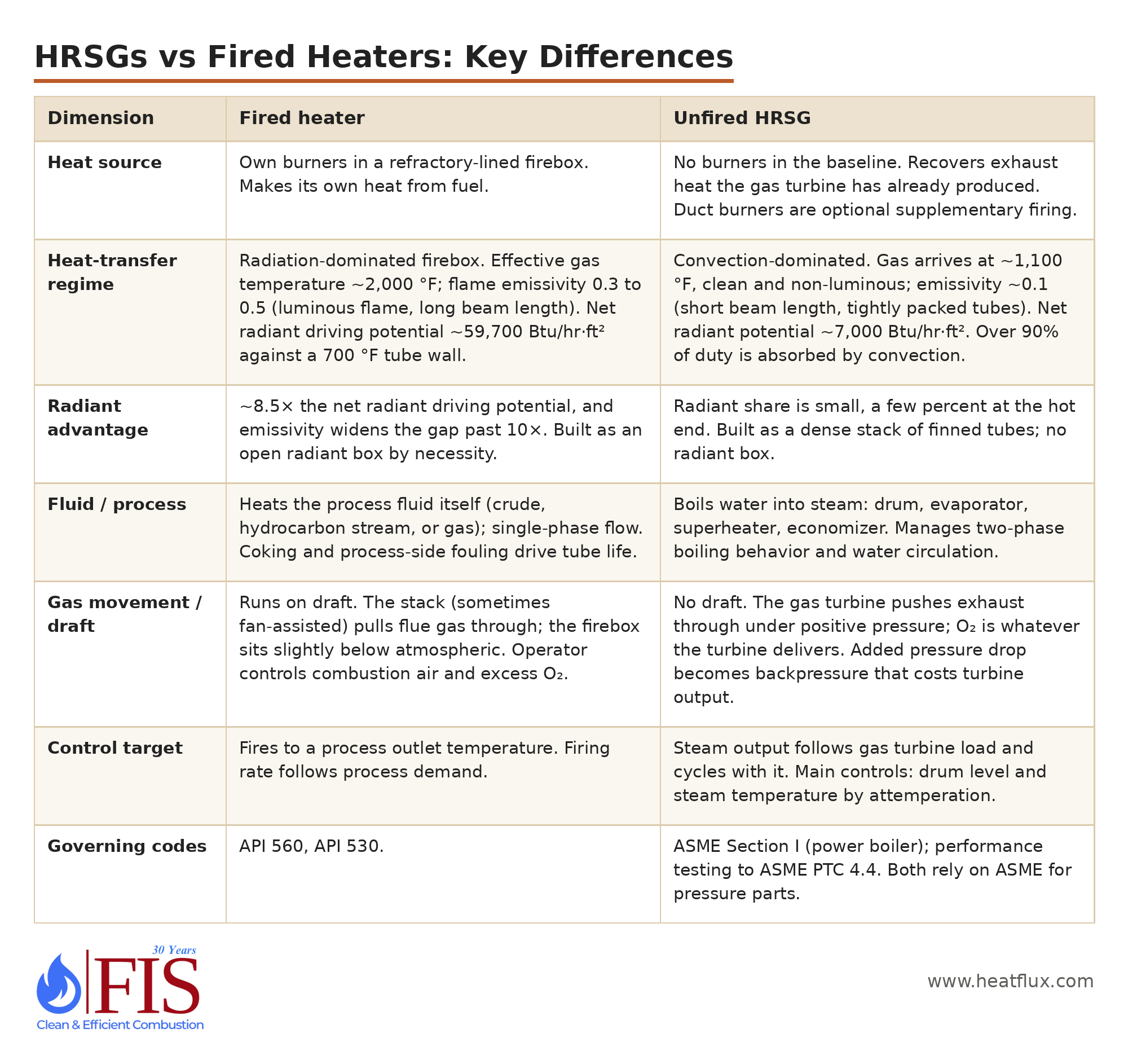
The heat source. A fired heater has its own burners and a refractory-lined firebox. An unfired HRSG has no burners at all; the gas turbine upstream did the burning, and the HRSG simply takes the exhaust. Add a duct burner and the HRSG can fire supplementary fuel, but that is an option, not the baseline.
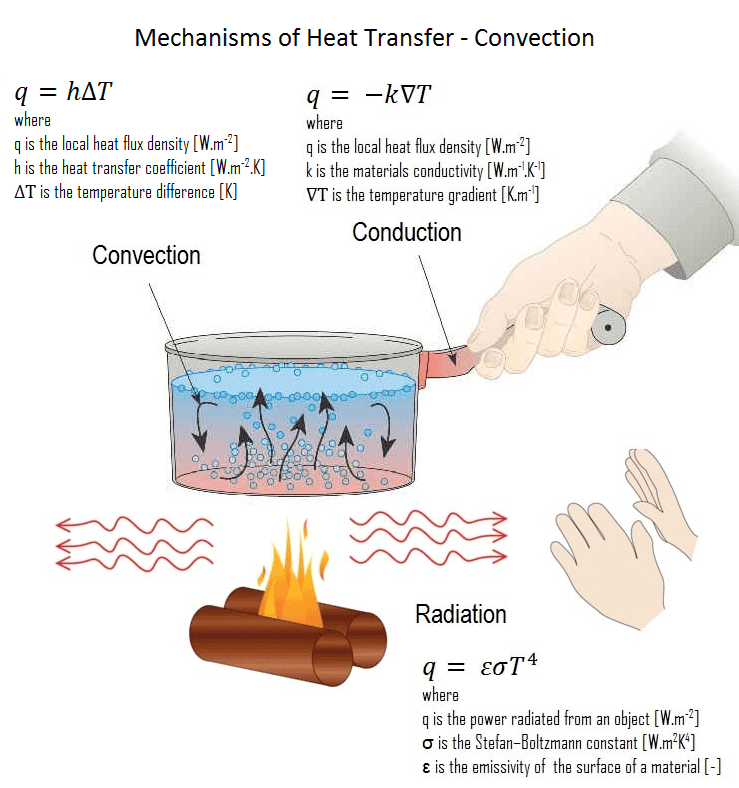
Image Source: www.nuclear-power.com
The heat-transfer regime. This is the big one. In a firebox the effective gas temperature is around 2,000 F, well above the 1,500 to 1,700 F you read at the bridgewall, and heat moves to the tubes mainly by radiation. In an unfired HRSG the gas arrives at roughly 1,100 F and heat moves almost entirely by convection. Radiation scales with the fourth power of absolute temperature, so the radiating power of the gas is far higher in the firebox:
Blackbody radiating power of the gas, Eb = σ × T⁴
(σ = 0.1714 × 10⁻⁸ Btu/hr·ft²·°R⁴,  T = °F + 460)

Fired heater firebox (~2,000 °F):   0.1714 × 10⁻⁸ × 2,460⁴ ≈ 62,800 Btu/hr·ft²
Unfired HRSG gas path (~1,100 °F):  0.1714 × 10⁻⁸ × 1,560⁴ ≈ 10,200 Btu/hr·ft²
The radiating potential is about six times higher in the firebox from temperature alone, and that is the conservative version of the comparison. Radiation actually drives on the difference T_gas⁴ − T_wall⁴, so against a 700 F tube wall the firebox net driving potential is roughly 59,700 Btu/hr·ft² against 7,000 for the HRSG, a factor of eight and a half. Emissivity widens the gap again. A firebox holds a luminous flame with a long beam length and an effective emissivity in the range of 0.3 to 0.5, while HRSG gas is cooler, clean, and non-luminous and flows through tightly packed tubes with a short beam length between them, closer to 0.1. Put those together and the radiant advantage of the firebox is better than an order of magnitude. So a fired heater absorbs a large share of its duty as radiation in the firebox, and an HRSG absorbs well over 90 percent of its duty by convection, with only a few percent of non-luminous gas radiation in the hot-end panels. That is why a fired heater is built around an open radiant box and an HRSG is a dense stack of finned tubes.
The fluid. A fired heater heats a process fluid, a crude or hydrocarbon stream or a gas, that flows through the tubes and is the product, so coking and process-side fouling are constant concerns. Many refinery heaters also run two-phase: the process fluid is a mixture of hydrocarbons with a wide boiling temperature range, and as temperature rises and pressure falls along the coil, progressively heavier components vaporize. The molecular weight, density, viscosity, and thermal conductivity of both phases change continuously, so managing the flow regime during vaporization and controlling the inside film temperature are central to effective heat transfer and to preventing degradation of the bulk fluid. An HRSG boils a pure component, water, with a sharp boiling point, so it is a boiler: steam drum, evaporator, superheater, economizer, and the circulation design that goes with them. The difference is not that one boils and the other does not; it is mixture vaporization over a wide boiling temperature range against pure-component boiling at a fixed temperature.
The metallurgy. Fired heater coil materials range from carbon steel to high-alloy and cast tubes, driven by the contaminants and corrosive species in the process fluid; each attack mechanism has its own temperature range where it is most aggressive. HRSG pressure parts are mostly carbon and low alloy steels, selected primarily by tube metal temperature.
Gas movement and draft. A fired heater runs on draft. The stack, sometimes assisted by a fan, pulls flue gas through the heater, the firebox sits slightly below atmospheric pressure, and the operator controls combustion air and excess oxygen to hold efficiency. An HRSG has no draft in that sense. The gas turbine pushes the exhaust through it under positive pressure, the oxygen content is whatever the turbine delivers, and any pressure drop the HRSG adds shows up as backpressure that costs turbine output.
The control target. A fired heater fires to a process outlet temperature, and firing rate follows process demand. An unfired HRSG's steam output follows the gas turbine, rising and falling with turbine load and cycling with it, and its main controls are drum level and steam temperature by attemperation.
The codes. Fired heaters are designed to API standards such as 560 and 530. HRSGs are power boilers under ASME Section I, with performance testing to ASME PTC 4.4. Both rely on ASME for pressure parts.
Primary design and performance considerations
For a fired heater, the make-or-break items are radiant heat flux and its uniformity, the flame pattern and the avoidance of flame impingement on tubes, burner design and NOx, excess air and thermal efficiency, and process-side coking and tube life.
For an HRSG, they are the pinch point and approach temperature that set how much steam you get, the number of steam pressure levels, drum and circulation design, gas-side pressure drop and its turbine backpressure penalty, cycling and thermal transients along with the drain and attemperator logic that go with them, and duct burner oxygen margin if the unit is fired.
Shared by both, and often where the real problems live, are tube metal temperature, cold-end corrosion and acid or water dewpoint, fin selection, flow distribution, and materials matched to the actual gas and fluid.
Why this matters
The engineering that is hardest to learn lives on the fired-heater side: the radiant firebox, combustion, flame-to-tube heat transfer, and the metallurgy of high-flux service. An HRSG is in many ways the more forgiving equipment, with cooler gas, clean fuel, and an all-convective duty that looks like a fired heater's convection section scaled up. A firm that rates and revamps fired heaters already owns the heat-transfer, fin, fouling, dewpoint, draft, and CFD toolkit an HRSG needs. The HRSG-specific pieces, pinch-point analysis, multi-pressure steam, circulation, and the forced-draft gas path, are well-defined additions on top of the same fundamentals, not a separate field.
That is the short version of why fired-heater engineering transfers cleanly to HRSG work, and why an independent heat-transfer specialist is a useful set of eyes on an HRSG specification or revamp.
The bottom line
Same physics, different equipment. A fired heater makes and radiates its own heat into a process fluid; an HRSG convectively recovers a turbine's exhaust heat into steam. If you understand one, the other is a set of well-defined differences, not a new discipline.
FIS provides independent engineering, audit, and revamp services for HRSGs and fired heat-transfer equipment for refiners, EPCs, IPPs, and data center energy teams. To scope an HRSG or fired heater review, contact us here or email info@heatflux.com.
Related reading: "Combined-Cycle Power for Data Centers: How the HRSG Fits" and "Duct Burners in HRSGs: A Practical Introduction."
This article is part of our HRSG Engineering Guide