
Gas Turbine Upgrades and the HRSG: What Changes Downstream
A short primer on how a gas turbine uprate changes the heat, flow, and steam the HRSG sees, and why those downstream effects deserve engineering before the upgrade is locked in.
Why this matters now
Load growth, much of it from data centers, has owners pushing existing gas turbines for more output and more flexibility. Uprates and upgrades are an attractive way to get there without building new units. But an upgrade is almost always sold and managed as a turbine project, and the heat recovery steam generator (HRSG) downstream of the turbine inherits the consequences. When the downstream effects are not engineered up front, they surface later as tube failures, lost steam temperature control, accelerated maintenance, or a shortfall against the output the upgrade promised.
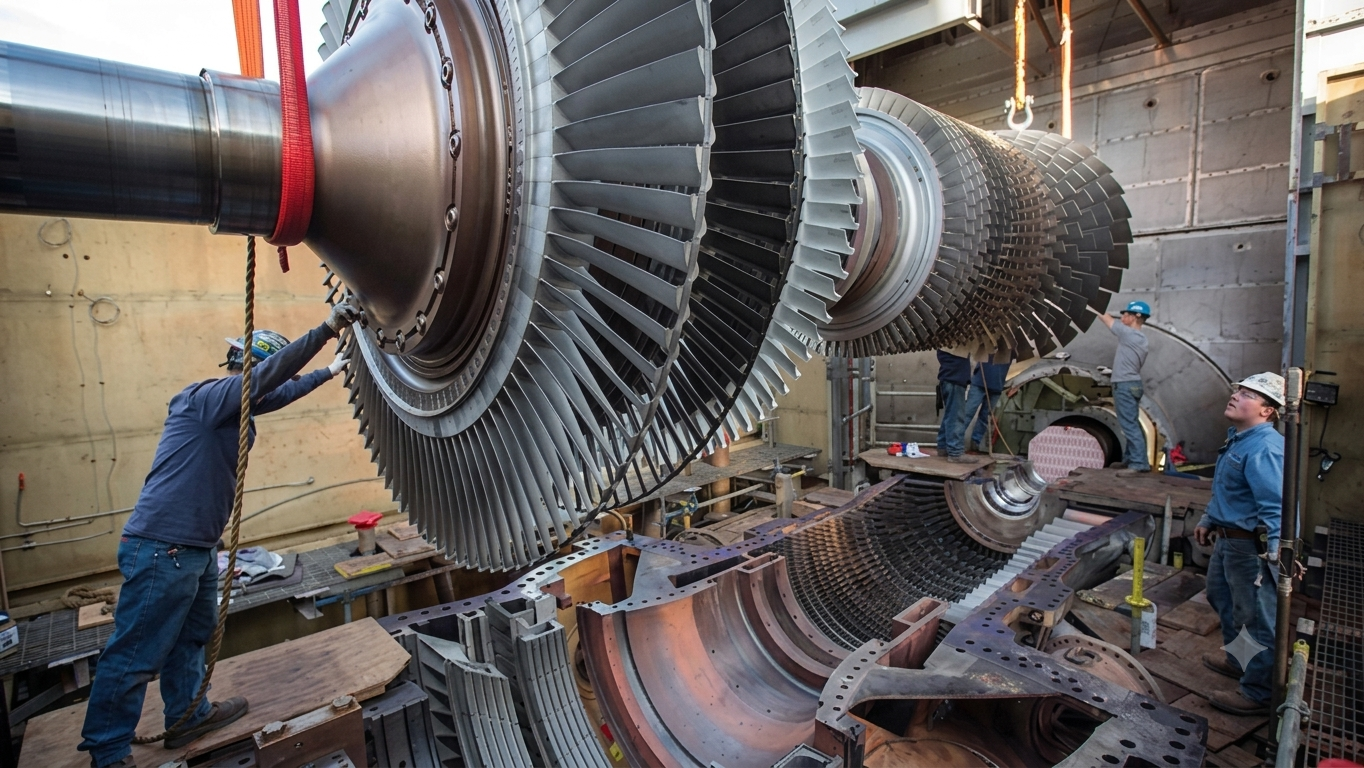
Image credit: Power Magazine
What an upgrade actually changes
Most performance upgrades pull one or both of two levers. Compressor upgrades increase airflow, which increases the exhaust mass flow into the HRSG. Firing-temperature increases raise the exhaust temperature into the HRSG. Some upgrades also shift the exhaust composition and oxygen content. The point for the HRSG is simple: after the upgrade it sees more gas, hotter gas, or both.
The mistake is to assume the HRSG, which was sized for the old turbine, simply absorbs the change. It does not. Every one of those shifts moves conditions across the boiler.
Downstream effect 1: more heat, and more steam
Start with the energy entering the HRSG. It is set by the exhaust flow, the gas temperature, and how far the gas is cooled:
Q = m_exhaust × Cp × (T_exhaust − T_stack)Take a representative case. The turbine exhausted 3,000,000 lb/hr at 1,100 °F. A compressor and firing upgrade adds 5% to the flow and 40 °F to the exhaust temperature:
Before:  3,000,000 × 0.26 × (1,100 − 300) = 624 MMBtu/hr
After:   3,150,000 × 0.26 × (1,140 − 300) = 688 MMBtu/hr
                                            ≈ 10% more energy into the HRSG
A modest-sounding 5% flow and 40 °F turns into roughly 10% more heat for the HRSG to absorb, and steam production rises with it. The steam drum, downcomers, superheater, and main steam piping were all sized for the old flow. More steam means higher tube and pipe velocities, more demand on steam separation in the drum, and pressure parts working closer to their limits than the original design intended.
Downstream effect 2: higher tube metal temperatures and attemperator demand
Hotter gas and more duty raise the heat flux into the tubes, which raises tube metal temperatures and eats into the metallurgical margin that sets tube life. The superheater and reheater absorb more heat, so they need more attemperator (desuperheater) spray to hold the target steam temperature.
That spray is where upgrades often bite. If the attemperator and its control valve were already near the edge, the added duty can leave you unable to control final steam temperature. Worse, if there is not enough energy to fully vaporize the extra spray water, the unvaporized water carries downstream and thermally shocks headers and tubes. Whether the attemperator is a probe or ring type, and whether there is enough straight pipe downstream, both decide if that water turns to steam before it reaches metal. None of this is visible if the upgrade is scoped as a turbine-only change.
Downstream effect 3: more backpressure on the turbine
More flow also means more gas-side pressure drop, and pressure drop costs turbine output. Pressure drop rises with roughly the square of flow:
ΔP_after / ΔP_before ≈ (1.05)² ≈ 1.10     (about 10% more, closer to 13% once the
                                           hotter, less dense gas is included)
Applying a standard rule of thumb, where each 4 to 10 in. w.c. of added backpressure costs roughly 1% of turbine output (smaller, older, and aeroderivative frames sit at the sensitive end; large modern F- and H-class machines are less so, and the exact value comes from the OEM correction curve). For a representative mid-size or mature frame near 1% per 4 in. w.c.:
Before:  12.0 in. w.c. → 3.0% of GT output
After:   13.6 in. w.c. → 3.4% of GT output
The penalty grows just as the turbine is making more power, so part of the uprate is quietly handed back through the stack. If the HRSG was already near a pressure-drop limit, the remaining margin shrinks further. The gas path, including ductwork and dampers, deserves a fresh look whenever flow goes up.
Downstream effect 4: transients, drains, casing, and liner
Upgrades often change startup gradients and ramp behavior, so drain logic and attemperator response have to keep pace or fast starts produce condensate and thermal transients. Higher gas temperatures raise the exposure of the casing and liner, which warp if pushed past their limits; standard internally-insulated supplementary firing is generally held to about 1,700 °F for this reason, and an upgrade can move the operating point toward it. If the unit has a duct burner, a change in exhaust oxygen or temperature also shifts the burner's firing and oxygen margin.
The fix: re-rate the HRSG before the uprate is locked
None of this argues against upgrades. It argues for treating the upgrade as a whole-plant change and checking the HRSG against the new exhaust conditions before the scope is fixed. A short, independent heat-transfer review covers it: re-rate the duty and steam production, check pinch points and tube metal temperatures, confirm the attemperator can both control temperature and fully vaporize its spray, check gas-side pressure drop and the backpressure penalty, and review casing, liner, drains, and any duct burner margin. That review is inexpensive next to a superheater tube failure, a missed performance guarantee, or an unplanned outage in year two.
This is the heat-transfer and revamp work FIS does. Decades of rating and revamping fired heat-transfer equipment in refining and power service translate directly into evaluating what a turbine upgrade does to the boiler behind it, independent of the turbine OEM's scope.
The bottom line
A gas turbine upgrade is never only a turbine change. The HRSG sees more flow, hotter gas, more steam, more spray, and more backpressure, and it is where the surprises land. Engineer the downstream effects before committing, and the uprate delivers what it promised instead of trading turbine output for HRSG problems.
FIS provides independent engineering, audit, and revamp services for HRSGs and fired heat-transfer equipment for EPCs, IPPs, and data center energy teams, including HRSG re-rates ahead of gas-turbine upgrades. To scope an upgrade-impact review, contact us here or email info@heatflux.com.
Related reading: "Combined-Cycle Power for Data Centers: How the HRSG Fits" for the basics, "Dampers and Draft Control in Cycling HRSG Plants" for the gas-path side, and "Duct Burners in HRSGs: A Practical Introduction" for an introduction to the duct burner.
This article is part of our HRSG engineering guide.